Managing business customers, processing registrations, and providing access to an online store can become complicated when businesses use separate systems for different activities. Salesforce and Shopify B2B integration makes this process simpler by connecting customer management with online purchasing. It helps businesses onboard new customers, manage company information, and provide a smooth shopping experience without unnecessary manual work.
Introduction
In today's competitive business environment, companies need simple and efficient ways to manage their business customers.
Imagine a company that sells electric vehicle (EV) products to dealers, distributors, and other businesses. Every time a new business wants to purchase products, the company needs to collect business information, create customer accounts, provide online store access, and manage purchasing activities.
Handling all these activities manually can take time and create unnecessary complications.
This is where Salesforce and Shopify B2B integration becomes useful.
By connecting Salesforce with Shopify, businesses can simplify customer onboarding, organize business information, and make online purchasing easier for their customers.
Understanding the Business Scenario
Let's understand this with a real-world example.
Suppose VoltNexa is a company that sells electric vehicle chargers and other EV-related products to businesses.
A new business, ABC Motors, wants to purchase 50 EV chargers for its operations.
To complete this purchase, ABC Motors needs to:
- Register its business information.
- Provide contact details of its representative.
- Get access to the online store.
- View products and business-specific pricing.
- Place bulk orders.
- Use the payment terms offered by VoltNexa.
Without an automated process, the sales team may need to perform several steps manually.
With Salesforce and Shopify B2B integration, these activities become much easier.
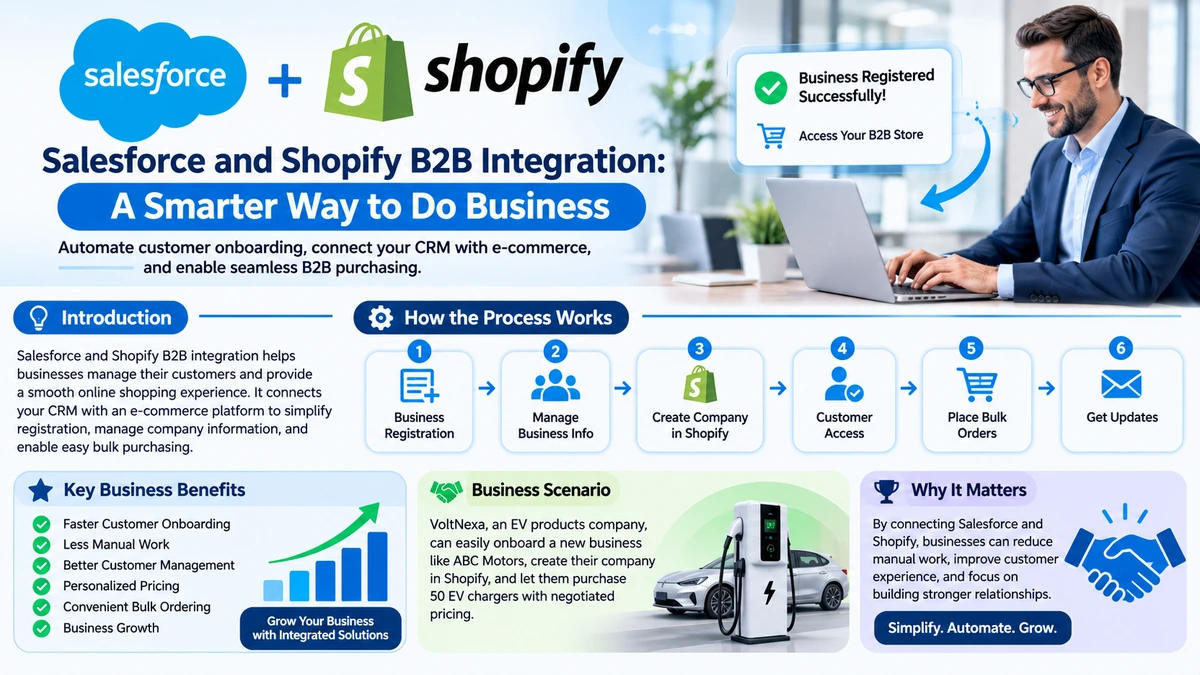
How the Process Works
1. Business Registration
The process starts when a new business wants to become a customer of VoltNexa.
The business submits its information through a registration form, including:
- Company Name
- Contact Person
- Business Email
- Phone Number
- Business Address
- GST Number
- Tax Information
This information helps the company understand who is interested in purchasing its products.
2. Business Information Management
Once the registration is submitted, the business information becomes available to the sales team in Salesforce.
The sales team can review the submitted details, verify the business information, and manage the customer relationship.
This provides a central place to manage business customers instead of maintaining information in multiple places.
3. Automatic Company and Customer Setup
After the business is approved and its information is processed, its company profile and associated customer account are created in Shopify.
For example:
- Company: ABC Motors
- Associated Customer: Customer representing ABC Motors
The customer is connected to the correct business company.
This eliminates the need for the sales team to manually create the same company and customer information again in the online store.
4. Access to the Online Store
After the account setup process, the customer receives the necessary information to access the Shopify online store.
The customer can log in and browse products available to their business.
This makes it easier for business customers to explore products without having to contact the sales team for every product inquiry.
5. Personalized Shopping Experience
Different businesses may have different purchasing requirements.
For example, ABC Motors may receive special pricing based on its business agreement with VoltNexa.
Shopify B2B allows businesses to provide features such as:
- Business-specific product catalogs.
- Negotiated product pricing.
- Location-based product availability.
- Agreed payment terms.
- Business-specific purchasing options.
This helps provide a more personalized shopping experience to every business customer.
6. Easy Bulk Purchasing
Unlike regular customers, businesses often purchase products in larger quantities.
For example, ABC Motors may need 50 EV chargers instead of purchasing just one.
Through the online store, the customer can browse the available products, select the required quantities, and place an order.
Businesses can also benefit from purchasing arrangements such as Net 30 payment terms when configured for their accounts.
This makes the purchasing process more convenient for both the customer and the sales team.
7. Better Customer Communication
Communication is an important part of customer onboarding.
Email notifications help customers receive relevant information about their registration, account setup, and online store access.
This keeps customers informed and makes the onboarding experience more organized.
Challenges Businesses Can Overcome
Managing business customers across different platforms can create several operational challenges.
Manual Data Entry
When company and customer information must be entered separately into multiple systems, it increases the workload.
How Integration Helps:
Business information can be transferred automatically between Salesforce and Shopify, reducing repeated data entry.
Duplicate Customer Information
Maintaining customer records in separate systems can result in duplicate or inconsistent information.
How Integration Helps:
Connected customer management helps maintain better consistency and reduces unnecessary duplicate record creation.
Complicated Customer Onboarding
New business customers may have to wait while the sales team manually creates their accounts and provides store access.
How Integration Helps:
Automated company and customer setup makes the onboarding process faster and more organized.
Difficulty Managing Business Relationships
Sales teams may struggle to manage company details and individual customer information separately.
How Integration Helps:
Salesforce provides a central platform to manage business accounts and their associated contacts.
Limited Purchasing Convenience
Business customers may need to contact sales representatives repeatedly to check products, prices, and order quantities.
How Integration Helps:
Shopify B2B provides an online purchasing experience where customers can view their available products, applicable pricing, and purchasing options.
Key Business Benefits
Connecting Salesforce with Shopify B2B provides several benefits to businesses.
- Faster Customer Onboarding: New businesses can be registered and set up more efficiently.
- Less Manual Work: Reduces repetitive tasks for the sales team.
- Better Customer Management: Keeps company and customer information organized.
- Improved Shopping Experience: Allows business customers to browse and purchase products online.
- Personalized Pricing: Supports negotiated pricing and business-specific catalogs.
- Convenient Bulk Ordering: Makes it easier for businesses to purchase products in larger quantities.
- Better Communication: Helps keep customers informed during registration and onboarding.
- Business Growth: Provides a more organized process as the number of business customers increases.
Why Businesses Need Connected Platforms
Modern businesses often use different platforms to manage sales, customers, and online purchasing.
However, when these platforms work independently, employees may need to repeat the same activities across multiple systems.
Connecting Salesforce and Shopify B2B creates a more organized business environment.
Salesforce helps businesses manage customer relationships, while Shopify provides an online platform for business customers to explore products and place orders.
Together, these platforms help reduce operational effort and create a smoother experience for both employees and customers.
Conclusion
Salesforce and Shopify B2B integration is more than just connecting two business platforms. It is about making everyday business activities easier and more efficient.
From business registration and customer onboarding to online store access and bulk purchasing, the integration helps create a connected experience for business customers.
For companies like VoltNexa, this approach can simplify the process of managing dealers, distributors, and corporate buyers while allowing customers to purchase products conveniently through an online store.
By reducing manual work, improving customer management, and simplifying online purchasing, businesses can focus more on building customer relationships and growing their operations.
Frequently Asked Questions
What is Salesforce and Shopify B2B integration?
It is a connection between Salesforce and Shopify that helps businesses manage their customers in one platform while providing an online purchasing experience through another.
How does this integration help business customers?
It makes registration, account setup, online store access, product browsing, and bulk purchasing easier for business customers.
Can a business have multiple customers?
Yes. A business company can have multiple associated customers who can access the online store according to their assigned permissions.
Can different businesses see different product prices?
Yes. Shopify B2B supports company-specific catalogs and negotiated pricing, allowing businesses to offer different purchasing arrangements to different customers.
Can business customers place bulk orders?
Yes. Business customers can purchase products in larger quantities through the online store, depending on product availability and purchasing configurations.
What are the main benefits for a sales team?
The sales team can reduce repetitive administrative work, manage customer information more efficiently, and spend more time building business relationships.
Is this integration useful for distributors and dealers?
Yes. It is particularly useful for businesses that sell products to dealers, distributors, wholesalers, and corporate buyers who regularly purchase products in bulk.