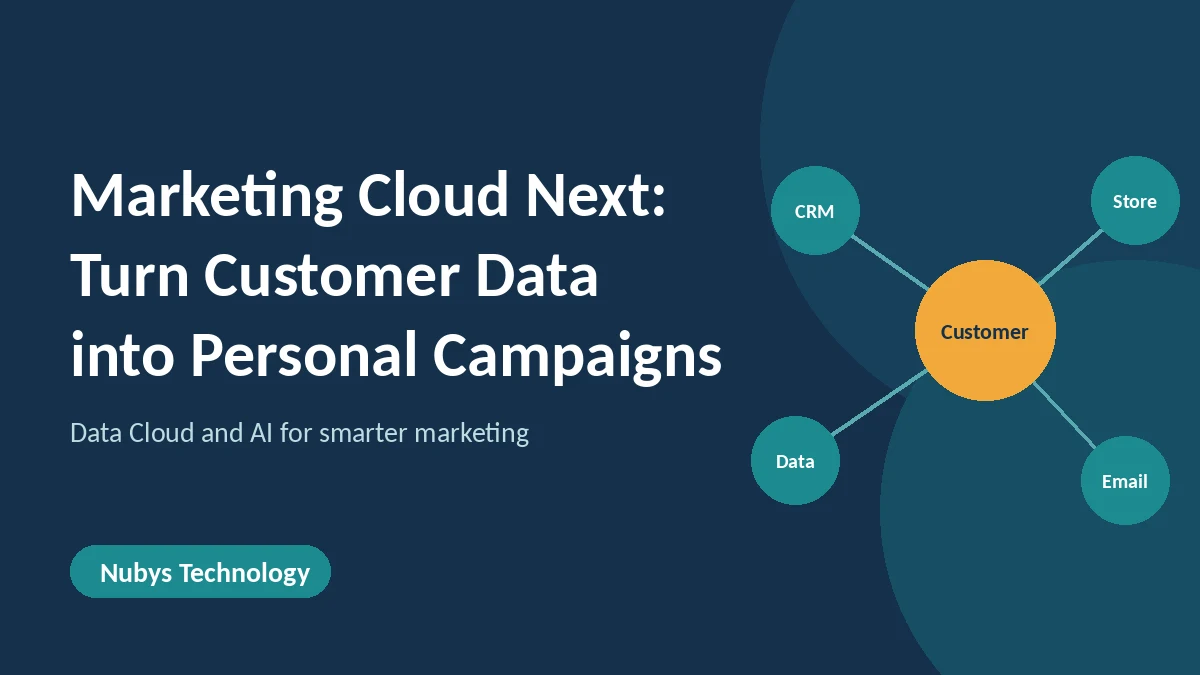
Marketing Cloud Next from Salesforce helps businesses turn scattered customer data into personal campaigns. Most companies already have the data they need, but it sits in the CRM, the online store, a data warehouse and a few spreadsheets. When the marketing team cannot see it all together, every customer gets the same email, and many messages are ignored. In this post, we explain what Marketing Cloud Next is, its main purpose, and how it helps a business in a practical way.
What is Marketing Cloud Next?
Marketing Cloud Next is Salesforce's marketing platform. It works with Data Cloud and AI, so marketers can plan campaigns, build audiences, create email content and track results in one place, using the same customer data as the rest of the company.
The main purpose: the right message, to the right customer, at the right time
The main purpose of Marketing Cloud Next is simple: help a business use its own customer data to talk to each customer in a way that fits them. This leads to three business goals:
- Win and grow customers. Reach the right people with offers they care about.
- Keep customers. Notice when someone is slipping away and act early.
- Use the marketing budget better. Stop sending the same message to everyone and see what really works.
Problems it solves for a business
- Scattered data. Customer details are in many systems, and nobody sees the full picture.
- Generic campaigns. One email goes to the whole list, so customers feel it is not for them.
- Slow campaign work. Building lists, writing content and setting up journeys by hand takes days.
- Unclear results. It is hard to tell which campaign helped sales and which did not.
- Teams out of sync. Marketing, sales and service each work from different customer information.
How Marketing Cloud Next helps your business
- Better customer understanding. One profile for each customer shows what they bought, when, and how they engage.
- More relevant messages. Customers get offers that match their behavior, which builds trust and improves response.
- Faster campaigns. AI helps draft briefs and content, so the team spends time on strategy instead of first drafts.
- Stronger loyalty. You can reward your best customers and win back the ones who stopped buying.
- Smarter spending. Send fewer, better messages to the people most likely to respond.
- Clear reporting. See which campaigns worked, then repeat what is working.
- One team, one view. Sales, service and marketing share the same customer data.
How it works
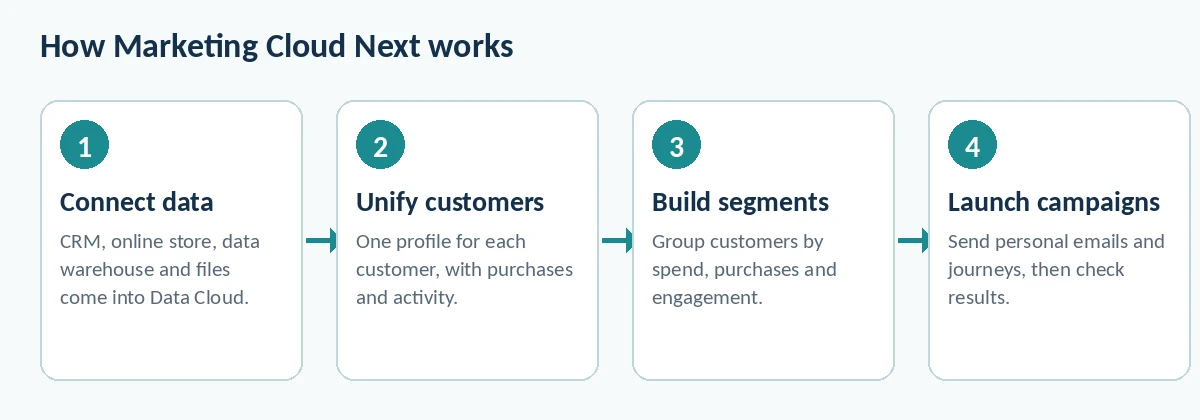 The four steps from scattered data to personal campaigns.
- Connect data. Data Cloud brings in data from Salesforce CRM, online stores, data warehouses such as Snowflake, and files.
- Unify customers. Matching rules join records for the same person into one customer profile.
- Build segments. Group customers by total spend, number of purchases and how engaged they are.
- Launch campaigns. Send personalized emails and journeys to each segment, then review the results.
Real business use cases
- Loyalty program. Reward top customers and encourage the next purchase.
- Win-back. Contact customers who have not bought for a long time with a message made for them.
- Welcome journey. Guide new customers through their first weeks with your brand.
- Product launch. Tell the customers who are most likely to care first.
- Cross-sell. Suggest related products based on what a customer already bought.
Example: a retail loyalty program
Our team built a proof of concept for a retail loyalty program using Data Cloud and Marketing Cloud Next. We joined data from Salesforce CRM, Snowflake, Shopify and CSV files, and created four customer groups:
| Segment | Who they are | What they get |
|---|---|---|
| VIP | Customers who spend the most and buy often | Early access and thank-you offers |
| Growth | Customers who buy sometimes | A nudge to buy more |
| At-Risk | Customers who have not bought for a long time | A win-back message |
| Highly Engaged | Customers who open and click often | New products and referral offers |
Each group gets a message that fits its situation, instead of one email for everyone.
Where AI helps: Agentforce for campaigns
Agentforce helps marketers start faster. You describe your goal in plain language, for example a seasonal offer for loyal customers. The agent drafts a campaign brief and email content, and it can help build the customer journey. Your team reviews and edits everything before anything is sent, so people stay in control.
Who in the business benefits?
- Marketing teams: faster campaigns and better targeting.
- Sales teams: better leads and a clearer view of customer interest.
- Customer service teams: context about what each customer has bought and received.
- Business leaders: clear numbers on what marketing delivers.
Common mistakes to avoid
- Starting with too many goals. Pick one clear goal first.
- Using poor-quality data. Clean key fields such as name and email before you begin.
- Making too many segments. Start with two or three.
- Sending without a review step. Always have a person check AI-written content.
- Ignoring consent. Respect customer permissions and local email laws.
How to get started
- Choose one business goal, such as loyalty or win-back.
- List where your customer data lives.
- Connect the main sources and unify the customer profiles.
- Build two or three segments and one campaign.
- Measure the results, learn, and then grow to more campaigns.
Frequently Asked Questions
Do we need Data Cloud for Marketing Cloud Next?
Marketing Cloud Next works best with Data Cloud, because that is where unified customer data and segments come from.
Does AI send emails by itself?
No. AI helps draft campaigns and content, and your team reviews and approves them before sending.
Is Marketing Cloud Next only for large companies?
No. Any business with customer data in more than one place can benefit. Starting small with one use case is a good way to begin.
Talk to our team
Want to try this in your business? Nubys Technology is a Salesforce consulting partner. Contact our team to talk about Data Cloud and Marketing Cloud Next for your marketing goals.